· 6 min read
Escaping the Pixelated Cave: Why Plato's Allegory Still Matters
Founder of Cogletta
Sometimes, while scrolling through social media, I find myself wondering how much of what I am seeing actually represents the world outside my screen.
It sounds like a very modern problem, but the question behind it is surprisingly old.
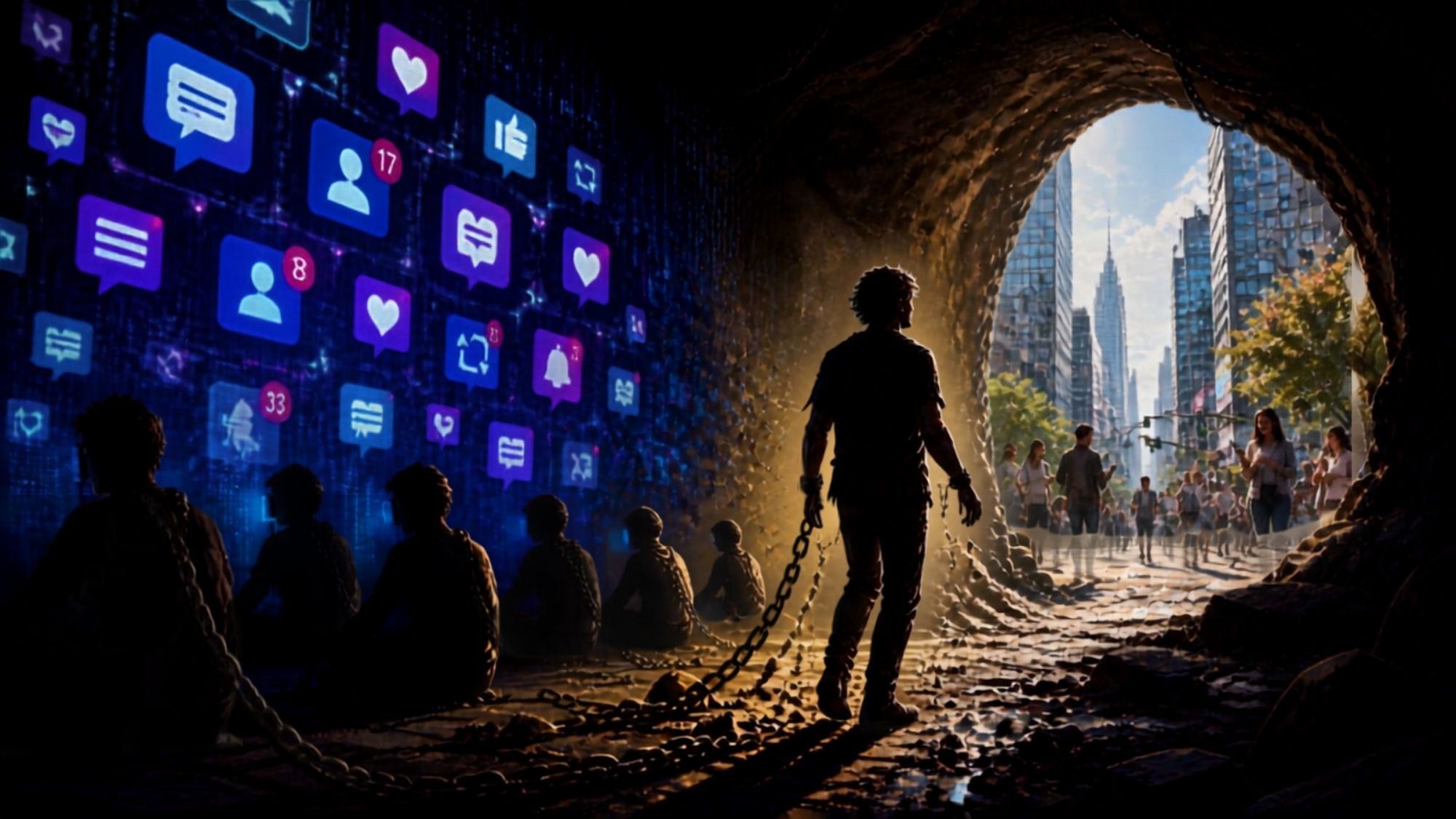
More than 2,400 years ago, Plato explored something similar in his Allegory of the Cave, found in The Republic. His story is usually discussed in relation to knowledge, education, and the difference between appearance and reality. But it is difficult to read it today without thinking about social media, algorithms, news feeds, and the enormous amount of information that reaches us through screens.
The technology has changed. The problem may not have changed as much as we think.
Plato's Cave
Plato asks us to imagine a group of people who have spent their entire lives chained inside a cave. They are facing a wall and cannot turn around.
Behind them is a fire. Between the fire and the prisoners, other people carry objects back and forth. The prisoners cannot see the objects themselves. They see only the shadows cast on the wall in front of them.
Because these shadows are all they have ever known, they naturally assume that the shadows are reality.
One prisoner is eventually freed. He turns around, sees the fire and the objects behind him, and slowly begins to understand that what he previously believed to be real was only an image of something else.
Then he leaves the cave.
Outside, the sunlight is initially painful. He cannot immediately see clearly. Gradually, however, his eyes adjust, and he begins to see a much larger world.
What interests me most about the story is that the prisoner was not stupid while he was inside the cave. He simply had no reason to imagine a reality beyond the one available to him.
That is also what makes the allegory uncomfortable.
Our Own Shadows
Most of what we know about the world does not come from direct experience.
I have never personally witnessed most of the political events, wars, scientific discoveries, economic crises, or social movements I have opinions about. I know about them because someone reported them, filmed them, wrote about them, commented on them, or shared them.
That is unavoidable. No person can experience everything directly.
The problem is that today there is another layer between us and the world: algorithms.
Social-media platforms do not simply show us everything that happens. They choose what appears in front of us. What we see can depend on what we have clicked before, what makes us stay on a platform longer, what people similar to us engage with, and what generates a strong emotional reaction.
This does not mean everything on social media is false. That would be too simple. The more interesting problem is that even true information can create a distorted picture when it is selectively presented.
If I repeatedly see one kind of political opinion, one interpretation of an event, or one particular fear, after a while it can begin to feel like this is simply what everyone thinks.
My feed can start to look like the world.
But it is not the world. It is a selection from it.
In that sense, Plato's shadows have not disappeared. We have simply developed much more convincing ways of projecting them.
Why Leaving the Cave Is Uncomfortable
Another part of Plato's allegory feels especially relevant today: leaving the cave hurts.
The prisoner does not step into the sunlight and immediately feel grateful. The light overwhelms him. His old reality, although false, was at least familiar.
Something similar happens when we encounter information that seriously challenges what we already believe.
It is easy to imagine ourselves as open-minded people who simply follow the evidence wherever it goes. In practice, changing our minds can be surprisingly difficult. Our opinions are often connected to our identities, friendships, political loyalties, communities, and past experiences.
Discovering that we may have been wrong is not just an intellectual experience. Sometimes it feels personal.
This may be one reason misinformation and echo chambers are so powerful. Information that confirms what we already believe asks very little from us. Information that contradicts us asks us to reconsider ourselves.
Education, at its best, should probably create some of this discomfort.
Learning is not only about gaining new information. Sometimes it means realizing that something we were confident about was incomplete, exaggerated, or simply wrong.
But How Do We Know We Are Outside?
There is another problem, and I think it makes Plato's allegory even more relevant.
How do we know that we are the person who escaped?
It is very easy to use the cave as a metaphor for other people. We can look at someone whose politics, religion, lifestyle, or worldview is different from ours and think: they are still staring at the shadows.
But that interpretation misses something important.
What if we are too?
Our understanding of reality is influenced by our culture, education, experiences, social environment, and the information we happen to encounter. Even when we become aware of one bias, there may be another one that we cannot yet see.
- There are things we know.
- There are things we know we do not know.
- And, more disturbingly, there are probably things we do not even know that we do not know.
Those are the things that make the cave such a powerful metaphor. A prisoner cannot question what lies outside the cave if the idea of an outside has never occurred to him.
Perhaps the modern version of escaping the cave is therefore not reaching a point where we finally possess the truth. Maybe it is developing the habit of questioning how we arrived at what we think is true.
- Who is giving me this information?
- What might be missing?
- Why does this particular story keep appearing in front of me?
- Would someone with different sources see the same event differently?
- And, most importantly: what could I currently be completely wrong about?
The Digital Cave
We live in a strange period of history. More information is available to us than to almost any previous generation, yet access to information does not necessarily mean access to truth.
In fact, having so much information may create a new problem. We cannot examine everything ourselves, so we depend on filters — journalists, institutions, search engines, influencers, algorithms, and increasingly artificial intelligence — to decide what reaches us.
Some of those filters are useful. Some are unreliable. Most are imperfect.
That is why I think Plato's cave still matters.
Its lesson is not simply "do not trust social media" or "everyone else is manipulated." It is something more difficult: we should remain suspicious of our own certainty.
Perhaps we never completely leave the cave.
But we can at least keep turning our heads.
And every now and then, when the screen in front of us begins to feel like the whole world, it is worth asking:
Am I seeing reality — or only one of its shadows?